
parable.school
Sumi-e ink brushwork of a single lion lying asleep in a clearing, head resting on paws, body rendered in two or three confident calligraphic brushstrokes, alone in empty space

A lion lay sleeping in a clearing.

Sumi-e ink brushwork of a small mouse running across open ground, tail trailing, alone in empty space

A small mouse, hurrying, ran across his paw.
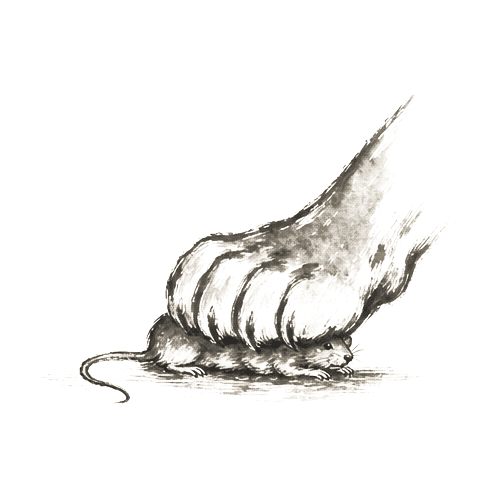
Sumi-e ink brushwork of a lion’s heavy paw over a tiny mouse, the rest of the lion implied by a single stroke

The lion woke. He pinned the mouse with one heavy claw.
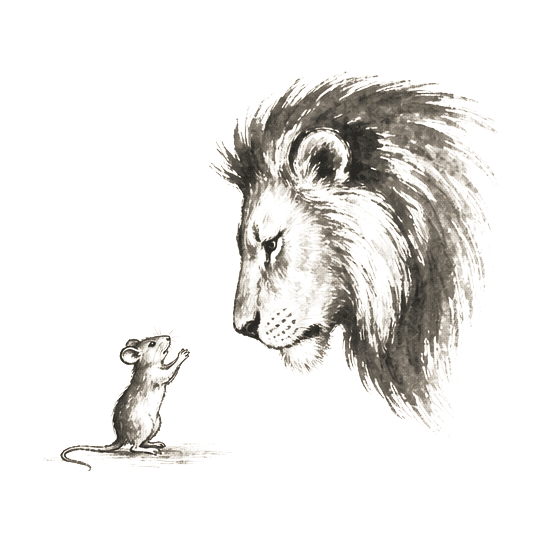
Sumi-e ink brushwork of a small mouse standing on hind legs, paws raised in supplication, before the great face of a lion

“Spare me, great king,” the mouse said. “Let me live, and perhaps one day I will repay you.”

Sumi-e ink brushwork of a lion’s head with mouth open, sharp teeth visible, alone in empty space

The lion laughed — the thought of a mouse repaying a lion. But he lifted his paw, and let her go.

·
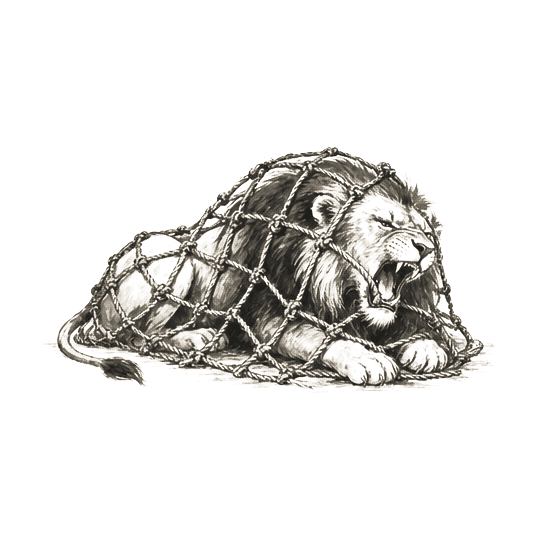
Sumi-e ink brushwork of a lion trapped inside a rough net of thick strands, mouth open, alone in empty space

Some time later, hunters caught the lion in a net of strong rope and bound him to a tree. He roared. He thrashed. The ropes only bit deeper.

Sumi-e ink brushwork of a small mouse with ears raised, alone in empty space

The mouse, passing, heard the roar.

Sumi-e ink brushwork of a small mouse perched on the strands of a thick rope net, mouth pressed to the rope

She came. She climbed the net. With her small teeth she gnawed, and gnawed, and gnawed — and the ropes parted.

Sumi-e ink brushwork of a lion with broken strands still around its body, alone in empty space

The lion stepped free.

χάρις
khárisfavor returned

lineage

Aesop is the name attached to a body of fables that almost certainly outgrew any one teller. Tradition places him in the sixth century BCE, in slavery on Samos, and credits him with a sharp tongue and an ugly face — both common signatures of the trickster-sage in Greek memory.

οὐδεὶς εὐτελής

“No one too small.” — the Aesopian moral attached to this fable in late antiquity.

The earliest written forms come from Babrius, who versified Aesop in Greek, and Phaedrus, who Latinized him for the Roman audience. The Perry Index — the standard catalog of Aesopica — numbers this one 150.

Most of Aesop is sharp and unsentimental: cunning consequences, vanity punished. This one is gentler. The lion releases the mouse on a kind of cosmic shrug — why not — and the parable does not let that small mercy be wasted.

Gratitude in the fable is not symbolic. It is small, and physical, and made of teeth. The mouse climbs the net.