
parable.school
Sumi-e ink brushwork of a single robed water bearer with a long pole across his shoulders, a clay pot hanging from each end of the pole, alone in empty space

A water bearer in India had two large pots — one on each end of a pole he carried across his shoulders.

One pot was perfect. From the stream to the master’s house, it held a full measure of water.

Sumi-e ink brushwork of a single clay pot with a visible vertical crack running down one side, alone in empty space

The other had a crack. It arrived at the master’s house only half full.

Sumi-e ink brushwork of a long dusty path crossing empty space, a small bearer walking alone in the distance

For two years this went on. Every day, the bearer delivered one and a half measures of water.
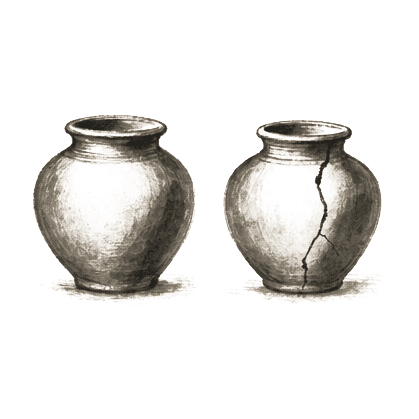
Sumi-e ink brushwork of two clay pots set side by side on the ground, one whole and one with a visible crack, alone in empty space

The perfect pot was proud of its work. The cracked pot was ashamed of itself.
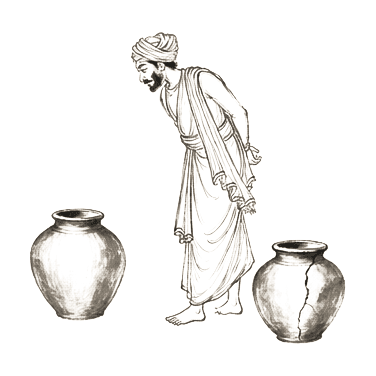
Sumi-e ink brushwork of a robed bearer beside two pots, head inclined as if listening to one, alone in empty space

At last, the cracked pot spoke. “I am sorry,” it said. “For two years, the crack in my side has cost you. You walk the same path. The master receives only half.”

Sumi-e ink brushwork of a robed bearer standing on a path, one hand gesturing gently to one side, the suggestion of a smile

The bearer smiled. “Did you notice that there are flowers on your side of the path? Not on the other.”

Sumi-e ink brushwork of a path with wildflowers blooming along one side and bare earth on the other, alone in empty space

“I have always known about your crack. So I planted seeds on your side. Every day, as we walk home, you water them.”“For two years I have picked those flowers, and brought them to the master’s table.”

·
Sumi-e ink brushwork of a small simple jar of cut wildflowers on a low wooden table, alone in empty space

“Without you being exactly as you are, the path would have no flowers, and his table no beauty.”

फूल
phūlflower

lineage

The story is widely told across the Indian subcontinent. Its setting is unmistakably South Asian — the water bearer with his shoulder pole, the daily walk to the master’s house, the dusty path between the stream and the threshold — and its themes are at home in Indian devotional teaching.

Its written record, like that of many folk parables, is shallow. The cracked pot enters Western collections through twentieth-century anthologies of Indian and Christian inspirational writing, and from there into business books, sermons, and message-board signatures. Older oral lineages probably exist; they are hard to fix in time.

The parable’s argument is sharp under the gentle surface. The cracked pot’s shame is the only thing in the story that is wrong. The crack itself is not a problem. The bearer has been working with it the whole time.

This is not a parable about acceptance, which would let the pot stay still inside its limits. It is a parable about use. The pot is leaking. Something good is being grown by the leak. The pot was never less, only differently shaped, with a path of flowers behind it the perfect pot would never make.

Your flaw is watering something. Notice the flowers on your side of the path.